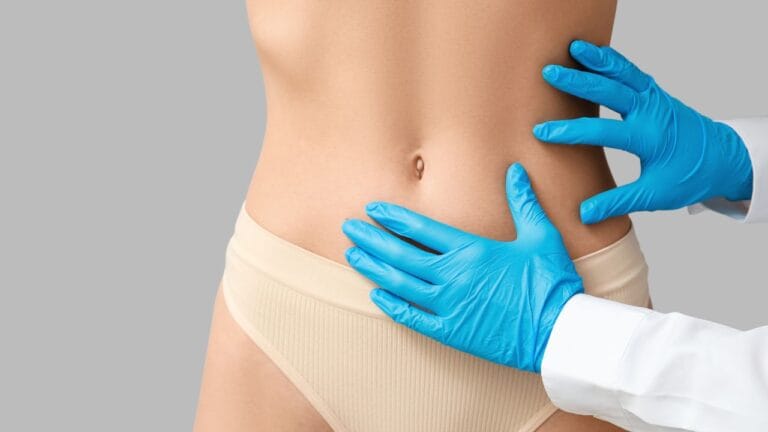

One of the questions I hear most in consultations, and that is most repeated in messages and video calls, is: how long do I have to wear the garment? And what happens if I take it off?
The garment after abdominoplasty is not an accessory. It is a clinical tool that plays a direct role in your recovery and in the final result. And in this article, I am going to explain why it is so important, what type you need, how long to use it, and how to use it correctly.
Key Points
- The garment after abdominoplasty is an essential clinical tool that reduces swelling, prevents seroma, promotes skin retraction, and contributes to contour definition during recovery.
- Use exclusively a post-surgical medical compression garment; shaping garments do not provide the adequate compression or design for a surgical postoperative period.
- During the first 4 weeks (stage 1), the garment is worn 24 hours a day with only brief removal for personal hygiene; from week 5, the transition to stage 2 with moderate compression begins.
- Check the fit of your garment frequently, as when inflammation decreases your abdomen reduces volume and the garment may need to be changed to a smaller size.
- Not wearing the garment as instructed increases the risk of seroma, prolonged inflammation, irregular skin retraction, and alterations in the final contour.
- Your surgeon is the one who determines the type of garment, the size, and the exact time to transition between stages or discontinue use.
Why Is a Garment Used After Abdominoplasty?
After an abdominoplasty, the abdominal tissues are in a state of recovery: the muscle wall was repaired, the skin was tensed, and in many cases liposculpture was also performed. All of this generates inflammation, which is a normal response of the body, but one that needs to be managed.
The postoperative garment fulfills several concrete functions in this context:
- Reduces post-surgical edema: uniform compression helps the accumulated fluid in the tissues drain naturally, instead of staying and causing swelling.
- Prevents seromas: by keeping the tissues in contact, it decreases the space where serous fluid could accumulate.
- Promotes skin retraction: keeps the skin fixed to the new abdominal contour, helping it adapt to its definitive shape.
- Protects the operated area: limits sudden movements that could compromise sutures or dissection planes.
- Contributes to contour definition: by holding the tissues in their new position during the most critical weeks, the final result is more defined and symmetrical.
It is important that you understand something: the garment does not work magic. It does not replace rest, medical follow-up, or postoperative discipline. But without it, recovery becomes more complicated and the final result can be compromised.
In my practice, recovery is supported by absolute rest the first 10 days, compression garment, lymphatic drainage, and personalized medical follow-up. The garment is one piece of that puzzle.
What Type of Garment Is Needed?
Not just any garment will work. And this is a frequent confusion: many patients arrive with shaping garments or department store girdles thinking they serve for the postoperative period. They do not.
There are several types, and the choice depends on the procedure you had and your surgeon’s recommendation:
- Complete abdominal garment: covers from below the bust to the hips. It is the most common for standard abdominoplasty.
- Full body garment: covers the entire torso including thighs. Used when abdominoplasty is combined with liposculpture of thighs or flanks.
- Garment with straps: distributes weight on the shoulders, which provides greater comfort in long-term use. Useful for patients with back or shoulder discomfort.
- Custom-fit garment: personalized according to your exact size. Usually the most recommended for optimal results, although it depends on availability and the surgeon’s criteria.
Characteristics a Good Postoperative Garment Should Have
- Breathable material, preferably high-quality lycra.
- Front closure with hooks or clasps, no complicated side closures that require help to put on.
- Uniform compression, without points of excessive pressure.
- No aggressive internal seams that mark the skin.
- Crotch opening to facilitate bathroom use.
A fact worth mentioning: Colombian garments are internationally recognized for their quality and design adapted to postoperative recovery. Many international patients come to Colombia and take several garments with them.
How Long Should the Garment Be Worn?
This is probably the most repeated question. And the honest answer is: it depends on each case. But there are general guidelines that apply to most patients.
First Weeks
During weeks 1 to 4, the garment is worn 24 hours a day, 7 days a week. It is only removed briefly for personal hygiene. This is the compression stage 1: maximum firmness.
I know it sounds intense. But these first weeks are the most critical. The evolution of inflammation, skin adaptation, and internal healing depend largely on what you do during this period.
Weeks 4 to 8
From week 4 or 5, you generally switch to the stage 2 garment: moderate compression, more comfortable, lighter material. At this point, your surgeon may authorize removing it to sleep, depending on your progress.
Stage 2 no longer seeks to contain acute inflammation. Its main function is to shape and maintain the contour while the tissues finish settling.
After the Second Month
From week 6 to 8, garment use becomes optional and subject to the surgeon’s assessment. Some patients continue wearing it during the day for comfort. Others no longer need it.
The total usage time varies between 4 and 8 weeks depending on each case. What does not vary is the principle: the garment is used as long as your surgeon indicates, not as long as you feel like it.
Tips for Wearing the Garment Correctly
It is not enough to just put the garment on. You have to wear it properly. And there are practical details that make a difference:
How it should fit:
- Firm but comfortable. It should compress without making breathing difficult.
- Completely smooth on the skin. Folds create marks and uneven pressure zones.
- No areas where you feel excessive pressure, pain, or numbness.
Warning signs:
- If you have trouble breathing, it is too tight.
- If it leaves deep marks or you feel tingling, it needs to be adjusted.
- If it constantly moves, rides up, or you do not feel effective compression, it is probably the wrong size.
Garment care:
- Hand wash the garment with mild soap. No washing machine.
- Air dry. Do not iron or use a dryer.
- Do not use fabric softener, it affects the material’s elasticity.
- Have at least two garments to alternate while you wash one.
A point that many patients overlook: as inflammation decreases, your abdomen reduces its volume and the garment becomes loose. At that point, you need to change to a smaller size. Using a loose garment is almost as counterproductive as not wearing one.
Discipline with the garment is part of the same commitment you have with your recovery. It is not optional.
What Happens If I Do Not Wear the Garment?
I will be direct: not wearing the garment, or wearing it intermittently when the indication is continuous, can compromise the result. And that is not a scare tactic: it is what I see in real consultations.
Without adequate compression:
- Inflammation takes longer to resolve.
- The risk of fluid accumulation (seroma) in the subcutaneous space increases.
- Tissues do not adhere correctly to the new contour, which can affect the final result.
- The skin may retract irregularly.
I am not saying this to scare you, but so you understand that the postoperative period is not a passive phase. It is an active phase where you have responsibilities. The garment is one of them.
There is also the opposite scenario: forcing garment use when there are signs that indicate it should be adjusted. If the garment is too tight and causes pain, bruising, or breathing difficulty, it is not helping: it is harming. Always consult your surgeon before making changes.
Frequently Asked Questions About the Garment After Abdominoplasty
How long should I wear the garment after abdominoplasty?
Garment use after abdominoplasty is divided into stages. The first 4 weeks require use 24 hours a day with maximum compression. From week 5, you transition to moderate compression, and from week 6-8 use becomes optional according to surgical evaluation.
What is the difference between a post-surgical garment and a regular shaping garment?
A medical compression garment is designed for postoperative recovery: it offers uniform compression, adequate material, and specific design for surgical recovery. Shaping garments do not have sufficient compression and are not designed for clinical use.
What happens if I do not wear the garment after my abdominoplasty?
Not wearing the garment or wearing it intermittently increases the risk of seroma, prolonged inflammation, irregular skin retraction, and alterations in the final contour. Proper use is an essential part of the recovery protocol.
Can I sleep with the garment on after abdominal surgery?
Yes. During the first 4 weeks, the garment after abdominoplasty is worn day and night, removing it only briefly for hygiene. From stage 2, the surgeon may authorize removing it to sleep.
When should I change the garment size?
As inflammation decreases, the abdomen reduces its volume and the garment may become loose. At that point it needs to be changed to a smaller size to maintain effective compression. Your surgeon will assess the right time.
Is it normal to feel discomfort with the garment during the abdominoplasty postoperative period?
It is normal to feel firm pressure, but the garment should not cause intense pain, breathing difficulty, or numbness. If you experience any of these symptoms, consult your surgeon immediately to adjust the size or type of garment.