
One of the most common questions I hear during consultations is direct and legitimate: “Doctor, if I get a BBL, will my cellulite go away?” The short answer is that gluteal fat transfer can improve the overall appearance of the area, but it is not a cellulite treatment. And that difference matters much more than it might seem.
I understand the confusion. Social media is flooded with before-and-after photos where the buttocks look smoother, firmer, and more defined. It’s easy to assume the BBL “erased” the cellulite. But what actually happened is something else entirely, and I want to explain it to you with the honesty you deserve before you make any decision. In this article, I’ll break down what gluteal fat transfer does and doesn’t do when it comes to cellulite, how the procedure works, who the real candidates are, and what to expect during recovery.
Key Takeaways
- A BBL can visually improve the appearance of mild cellulite by filling in superficial depressions, but it is not a treatment to eliminate it.
- Cellulite is a structural issue of the connective tissue, not a fat problem, so gluteal fat transfer cannot modify the fibrous bands that cause it.
- With proper subcutaneous technique, the BBL is a safe procedure: a 2024 study with over 3,000 patients reported zero deaths.
- Between 70% and 80% of the transferred fat survives long-term, and the final BBL result becomes apparent between 3 and 6 months after surgery.
- To treat cellulite specifically, there are alternatives such as subcision, radiofrequency, and shockwave therapy, which can complement a BBL.
- Avoiding sitting directly on the buttocks and using a BBL pillow during the first few weeks is essential to maximize fat retention.
What Is Gluteal Fat Transfer (BBL)?
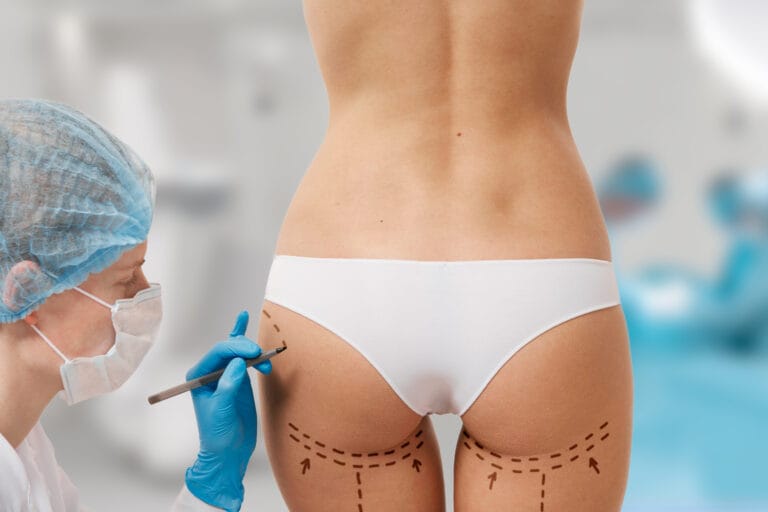
Gluteal fat transfer, known as BBL, short for Brazilian Butt Lift, is a surgical procedure that uses your own fat to increase volume and improve the shape of your buttocks. Instead of implants, fat is harvested from areas where you have excess (abdomen, back, flanks) and strategically re-injected into the buttocks.
The result I aim for is what I describe as a “heart-shaped derriere”: a natural shape with projection in the lateral and upper portion of the buttock. When combined with the waist reduction achieved through liposuction, the overall effect is what I call a “Latina mermaid body” — a defined waist, projected hips, and sculpted buttocks.
It’s important to clarify something: gluteal fat transfer is an optional complement to fat extraction. It is performed when the patient needs or requests it, not as a mandatory step in every liposculpture. If you want to learn more about the fundamentals of the procedure, you can review how gluteal fat transfer works.
How Does a BBL Work Step by Step?
Fat Harvesting
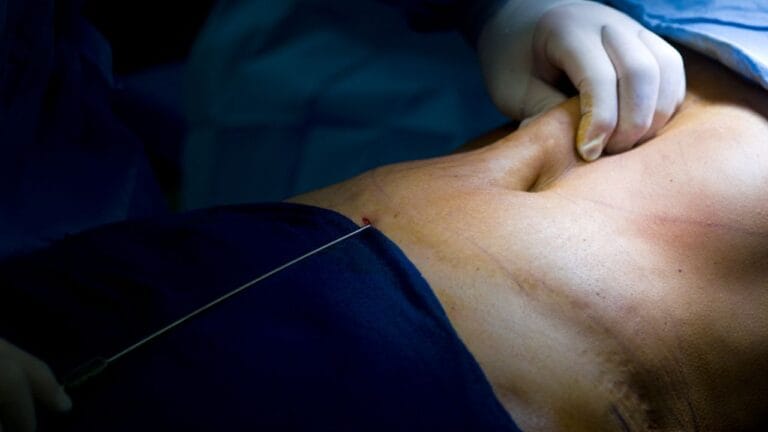
The first step is liposuction. Fat deposits are harvested from donor areas — typically the back, flanks, and abdomen — through small incisions. The harvesting technique matters: low pressure is used to avoid damaging the fat cells, because those cells need to arrive alive at their new destination.
Purification and Strategic Injection
Once harvested, the fat is purified. It is centrifuged and filtered to remove fluids, blood, and impurities, concentrating only the viable cells. Then comes the part that defines the result: strategic injection.
The fat is deposited in the lateral, upper, and middle areas of the buttocks, distributed in microdroplets to maximize cell survival. It’s not about “filling” like inflating a balloon. It’s a calculated distribution that aims for shape, projection, and harmony with the rest of the body.
BBL and Cellulite: Can It Improve Its Appearance?
This is where I need to be completely transparent with you.
What a BBL Can Improve Regarding Cellulite
By increasing buttock volume and strategically redistributing fat, a BBL can visually improve the appearance of the area. How? The injected fat fills in superficial depressions and improves the overall contour, which in some cases creates a smoother skin effect. It’s like stretching a wrinkled fabric: the irregularities become less noticeable.
But make no mistake: that does not mean the cellulite has disappeared.
What a BBL Cannot Improve
Severe cellulite (grade 3 or 4), with deep dimples visible even at rest, will not be resolved with a fat transfer. Nor will cellulite caused by deep fibrous bands in the connective tissue. A BBL does not treat the structural cause of cellulite — it can simply partially mask its appearance in mild to moderate cases. If you have questions about how liposculpture interacts with cellulite, I recommend reading that article where I explain it in detail.
Why Doesn’t Cellulite Disappear Completely with a BBL?
Cellulite is not a fat problem. It is a structural issue of the connective tissue.
Beneath your skin, there are fibrous bands (septae) that connect the skin to the deeper tissues. When those bands pull downward while the fat pushes upward, the characteristic dimples form. The fat injected during a BBL is deposited in the subcutaneous plane, but it does not modify or release those fibrous bands. It simply cannot.
That is why, even though the additional volume can visually “tighten” the area and smooth out mild irregularities, the underlying cause remains intact. It is a cosmetic improvement, not a treatment. And as a healthcare professional, according to sources like Mayo Clinic, cellulite affects the vast majority of adult women and has a genetic and hormonal component that no surgery can completely eliminate.
Alternatives and Complementary Treatments for Cellulite
If cellulite is your primary concern, there are treatments specifically designed to address its structural cause:
- Subcision (procedures such as Cellulaze or Aveli): these release the fibrous bands that create the dimples.
- Radiofrequency: stimulates collagen production and can improve skin firmness.
- Shockwave therapy: improves circulation and skin texture.
These treatments can complement a BBL, but it is essential to understand that each one has its own indications and limitations. The right combination depends on your particular case and requires an individual assessment. On WebMD you can find general information about the available options for cellulite.
Who Are the Ideal Candidates for a BBL?
Gluteal fat transfer is indicated for patients who lack waist definition and have flat buttocks — those cases where there is almost no visible difference between the back and the buttock. It is also for those who desire noticeable hip projection and buttock lifting.
But I don’t operate on just anyone. Candidacy is determined during the evaluation, assessing the amount of fat available in donor areas, skin quality, expectations, and overall health status. If there isn’t enough fat to transfer, or if your expectations aren’t realistic for your anatomy, I prefer to tell you honestly rather than promise something I cannot deliver.
You can learn more about the complete procedure on our gluteal fat transfer page.
BBL for Slim Patients: Is It Possible?
Yes, it is possible, but with moderate expectations. In slim patients, there is less fat available for transfer, which limits the volume that can be achieved. Liposuction from multiple areas — arms, back, abdomen, thighs — can be combined to obtain enough fat, but the projection will be more subtle than in patients with greater fat reserves.
This is not a negative thing. A natural and proportionate result may be exactly what your body needs. What matters is that your expectations are aligned with your anatomical reality, and that is something I define with you during the pre-assessment.
BBL Safety: Subcutaneous Technique and Recent Data
BBL safety has been a legitimate concern. The primary historical risk has been fat embolism, which occurs when fat is injected below or into the gluteus maximus muscle.
The good news is that the technique has evolved. A study published in 2024 on PubMed (PMID 38580866), with a series of over 3,000 patients, confirmed that the BBL is safe when fat is injected exclusively into the subcutaneous plane — that is, above the muscle. In that series, zero deaths were recorded.
International societies such as ISAPS now recommend exclusive subcutaneous injection, ideally guided by ultrasound to verify depth at all times. This is a standard that separates serious surgery from improvisation.
Fat Retention: How Long Does the Result Last?
Not all transferred fat survives. That is a fact you need to know. With proper technique — low-pressure harvesting, correct purification, and microdroplet injection — the literature reports that between 70% and 80% of transferred fat survives long-term.
The fat that successfully establishes blood supply within the first three months is considered permanent. The final result becomes apparent between 3 and 6 months, once the swelling subsides and the tissues settle. Not everything is immediate, and that requires patience.
Factors such as surgical technique, postoperative care, and weight stability directly influence how much fat is retained. If you want to understand how BBL results evolve week by week, I explain it in more detail in that article.
Recovery After a BBL
First Week
Complete rest with short, light walks to promote circulation. No sudden movements, lifting heavy objects, smoking, or consuming alcohol. These are not suggestions — they are non-negotiable rules. Your body needs to focus all its energy on integrating the transferred fat.
Weeks 2 to 6
You gradually increase mobility, but continue to avoid intense activity. This is the period where discipline defines the result. Your compression garment, BBL pillow, and your surgeon’s specific instructions are your daily guide.
Final Result: Month 3 Onward
Between the third and sixth month, the swelling subsides, the tissues settle, and you see the real result. By month 3, the fat that survived is considered permanent. From this point forward, maintaining a stable weight is key to preserving what was achieved.
How to Sit After a BBL
This is one of the most frequently asked questions and one of the most important instructions. You must avoid sitting directly on your buttocks for a minimum of 2 to 3 weeks. Some sources recommend extending this restriction to 6 to 8 weeks.
Why? Because direct pressure on newly transferred fat can compromise its survival. The cells need to establish blood supply, and sustained compression hinders that process.
During this period, sleep on your stomach or on your side. When you need to sit — because you inevitably will — always use your BBL pillow.
The BBL Pillow: What It Is and How Long to Use It
The BBL pillow is a special cushion designed to distribute your weight onto your thighs, avoiding direct pressure on the buttocks. It is not a luxury or an optional accessory. It is a recovery tool.
The recommended use is for a minimum of 2 to 3 weeks, ideally 6 to 8 weeks postoperatively. Every time you sit — in the car, at the table, anywhere — the pillow goes with you. This simple habit can make the difference between good fat retention and losing volume unnecessarily.
Compression Garments After a BBL
The compression garment is worn continuously for 4 to 6 weeks postoperatively. But there is an important detail that distinguishes a BBL garment from other surgical garments: it must have a buttock opening.
The donor areas — abdomen, back, flanks — need compression to reduce swelling and help the skin adapt. But the buttock area is not compressed, precisely to avoid flattening the transferred fat. It’s a balance: compression where retraction is needed, freedom where the fat needs to establish itself. If you have questions about the gluteal fat transfer procedure and its aftercare, consult directly with your surgeon.
Frequently Asked Questions About BBL and Cellulite
Does a BBL make cellulite worse?
No. La lipotransferencia no empeora la celulitis existente. En casos leves, puede incluso suavizar su apariencia al añadir volumen a la zona.
Can I get a BBL if I have severe cellulite?
You can, but don’t expect the cellulite to disappear. The BBL will improve the shape and projection of your buttocks, and that is valuable. However, for cellulite itself, you need specific treatments that address the fibrous bands.
How long does a BBL result last?
The fat that survives the first 3 months is considered permanent. Factors such as drastic weight changes can alter the long-term result.
Is a BBL safe in 2026?
With subcutaneous technique and in the hands of a board-certified plastic surgeon, recent data supports its safety. A 2024 study with over 3,000 patients reported zero deaths using exclusively subcutaneous injection.
When can I see the final result?
Between 3 and 6 months, when the swelling subsides and the tissues stabilize. If you are considering this procedure, the next step is a personalized pre-assessment where we evaluate your case, determine if you are a candidate, and set realistic expectations. Every body is unique and deserves a plan tailored to its needs.