
One of the questions I hear most in consultation is direct: “Doctor, will a tummy tuck remove my stretch marks?” And the honest answer is: it depends. It depends on where they are, how many you have, and what type of tummy tuck you need. Stretch marks are one of the reasons many patients, especially after pregnancy or significant weight changes, come to my office looking for a definitive solution. And yes, a tummy tuck can remove a significant number of stretch marks. But not all. Not always. In this article, I explain clearly what really happens with stretch marks after a tummy tuck, what you can expect and what you cannot, and how to prepare to make an informed decision.
Key Takeaways
What Are Stretch Marks and Why They Appear
Before talking about surgery, I need you to understand what stretch marks are from a medical perspective. They are not just a cosmetic concern: they give me valuable information about your skin quality and help me define what procedure is right for you.
How Stretch Marks Form on the Abdomen
Stretch marks are tears in the dermis, the middle layer of the skin, that occur when the tissue stretches beyond its elastic capacity. When that happens, the collagen and elastin fibers break. The visible result is those lines or marks you know well.
On the abdomen, this is especially common because it is an area that endures significant volume changes over relatively short periods.
Main Causes: Pregnancy, Weight Changes, and Genetics
Pregnancy is the most common cause in the patients I treat. The abdomen expands rapidly during pregnancy, and the skin does not always have enough elasticity to adapt without tearing. Significant weight changes, both gaining and losing, also cause stretch marks. And there is a factor many people underestimate: genetics. Some skin types simply have less resistance to stretching.
Types of Stretch Marks: Red vs. White and Their Importance
Red or purple stretch marks (striae rubra) are recent. They still have blood supply and some cellular activity. White or pearlescent ones (striae alba) are old: the tissue has already scarred and lost pigment.
Why does this matter? Because red stretch marks respond better to non-surgical treatments like microneedling or laser. White ones, on the other hand, are much harder to treat with conservative methods. When a patient arrives with multiple white stretch marks and excess skin, that tells me we are dealing with a case that needs surgery, not skin retraction technology.
Can a Tummy Tuck Remove Stretch Marks?
Yes, it can. But with important nuances you need to know.
How a Tummy Tuck Works to Remove Stretch Marks
During a tummy tuck, all the excess skin from the lower abdomen is removed. The stretch marks on that segment of skin are eliminated along with the resected tissue. It is that straightforward: if the stretch mark is on the skin that is removed, it disappears.
With my ArTummyTech technique, the incision is made in the lowest area of the abdomen, the pubic zone, so the scar remains well hidden in the bikini line. The size of that incision depends on the amount of tissue that needs to be removed.
Which Stretch Marks Can Be Removed and Which Cannot
This is where I need to be clear. Clinical literature indicates that a full tummy tuck can remove between 40% and 60% of abdominal stretch marks. That is significant, but it is not 100%.
The stretch marks that are removed are those located between the incision line and the navel. Those above the navel or on the lateral flanks are generally not removed.
Stretch Marks Below the Navel vs. Above the Navel
- Debajo del ombligo: se eliminan con la piel resecada. Es el beneficio más directo y predecible de la cirugía.
- Arriba del ombligo: se reposicionan más abajo al estirar la piel hacia la zona inferior, pero no se eliminan. Quedan en una posición más baja y generalmente menos visible.
- Estrías laterales (flancos): una abdominoplastia estándar no las afecta. Una abdominoplastia extendida puede abordar algunas.
In the case of a mini tummy tuck, the skin resection is smaller, so only the lowest abdominal stretch marks are removed.
A Safe Process From Start to Finish
“Cada cirugía comienza mucho antes del quirófano. Una preparación adecuada y una valoración rigurosa son la base de un resultado exitoso y seguro.”


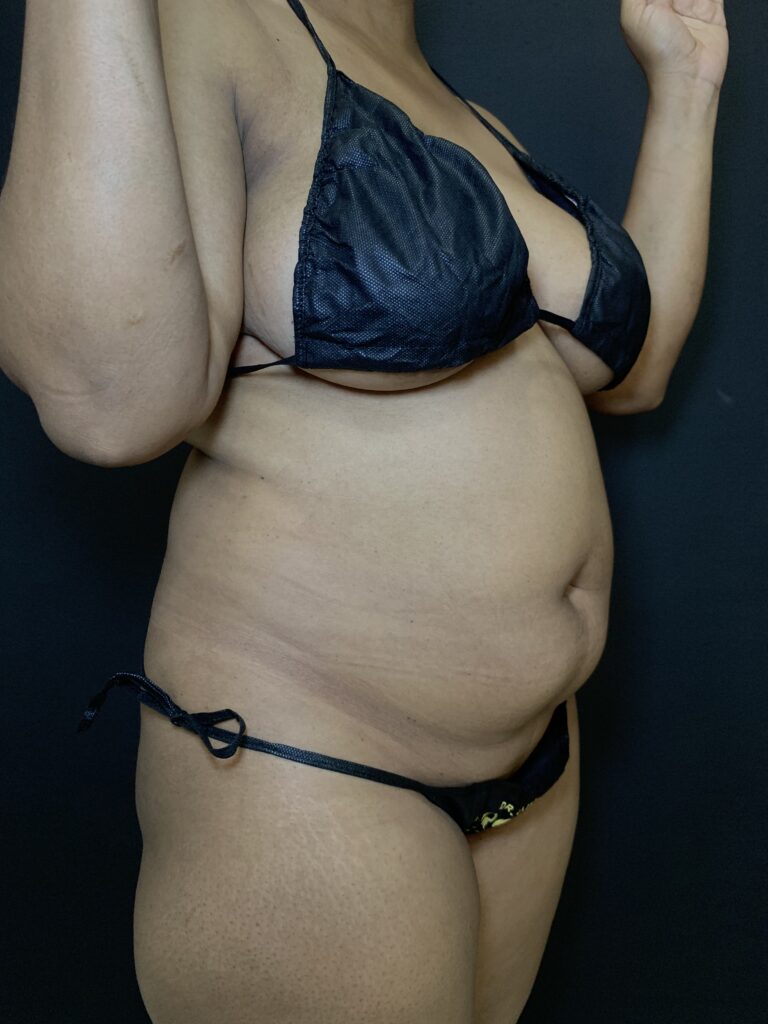
Before and After: Real Results with Stretch Marks
What to Expect Based on Stretch Mark Location
If most of your stretch marks are concentrated in the lower abdomen, between the pubis and the navel, the result will be very favorable. Those stretch marks go away with the skin we remove.
If your stretch marks are distributed mainly above the navel, the surgery’s impact on them will be limited. They are repositioned, may look slightly less noticeable due to the stretching, but they are still there.
The final result is seen between 3 and 6 months after surgery, when the skin fully settles and the scarring matures.
Realistic Expectations: Significant Improvement vs. Total Elimination
I will not sell you fantasies. The tummy tuck is the most effective surgical procedure for removing abdominal stretch marks. But it is not a “stretch mark treatment” in itself: stretch mark removal is an additional benefit of the skin resection.
Results vary by patient. The number of stretch marks, their distribution, skin quality, and the amount of tissue that can be resected all play a role. Every case is different, and that is precisely what is defined in the individual assessment.
Can New Stretch Marks Appear After a Tummy Tuck?
Yes, they can. And it is important that you know this before having surgery.
Risk Factors for New Postoperative Stretch Marks
The main factor is a new pregnancy. If you become pregnant after the tummy tuck, the abdominal skin will stretch again and new stretch marks may appear. Significant weight changes, gaining or losing a lot, can also generate new marks.
That is why I always recommend the tummy tuck be performed when the patient does not plan more pregnancies. This is not a whim: it is clinical judgment to protect your result.
How to Prevent New Stretch Marks
- Mantener un peso estable después de la cirugía.
- Hidratar la piel de forma constante.
- Evitar cambios bruscos de peso.
- Si planeas embarazarte, idealmente espera a después para operarte.
None of these measures guarantee 100% that new stretch marks will not appear, remember that genetics plays a role, but they significantly reduce the risk.
Myth vs. Reality: Tummy Tuck and Stretch Marks
Common Myths About Stretch Marks and Abdominal Surgery
“The tummy tuck removes all stretch marks.” False. It removes those on the resected skin, which corresponds to the lower abdomen. Stretch marks above the navel persist.
“Liposuction also removes stretch marks.” No. Liposuction removes fat, not skin. If you have multiple stretch marks and excess skin, liposuction is not your procedure. Those defects are not resolved by skin retraction technology: they require surgical removal of the affected tissue. To better understand the differences between both procedures and when each applies, it is useful to learn about how abdominal etching works as a complement or alternative depending on the case.
“Creams remove stretch marks after surgery.” No topical treatment removes stretch marks 100%. They can improve the appearance, especially of recent stretch marks, but they do not erase them.
What Science Says About Removing Stretch Marks with Surgery
The evidence is clear: the tummy tuck is the most effective method available for removing abdominal stretch marks. Studies report removal of 40-60% of stretch marks, concentrated in the lower abdomen. For residual stretch marks, there are complementary treatments such as fractional laser (CO2 or Erbium), microneedling, chemical peels, or platelet-rich plasma therapy. These can be applied after complete healing, usually at 3-6 months post-surgery. They improve texture and appearance, but none eliminates stretch marks completely.
How to Prepare If You Have Stretch Marks and Want a Tummy Tuck
What to Discuss with Your Surgeon About Your Stretch Marks
Before surgery, you need to have an honest and detailed conversation with your surgeon. These are the key questions:
- ¿Cuántas de mis estrías se van a poder eliminar con la cirugía?
- ¿Qué va a pasar con las que están por encima del ombligo?
- ¿Necesito una abdominoplastia completa, mini o extendida?
- ¿Hay tratamientos complementarios recomendados para después?
A surgeon committed to your result should be able to answer you clearly, without exaggerated promises. If someone tells you they will eliminate all your stretch marks, that should be a red flag.
The Importance of Personalized Evaluation
Every abdomen is different. The amount of excess skin, the distribution of stretch marks, the presence of abdominal diastasis, tissue quality: everything influences the surgical plan and what you can expect as a result.
In my practice, the individual assessment is where all these questions are answered. I evaluate comprehensively and adjust the plan to what your body needs, not the other way around. I do not operate on just anyone, and when a procedure is not advisable, I say so.
Recovery and Skin Care After Surgery
Recovery from a tummy tuck is not just waiting for the incision to heal. It is an active process that directly influences how your skin looks long-term, including the area where the stretch marks were.
During the first weeks, the compression garment is mandatory, 24/7, it is not optional. It helps the skin adapt to the new contour and reduces inflammation. Postoperative care instructions, follow-up checkups, and patient discipline are factors that impact the final result.
For the tummy tuck scar, which remains in the bikini area, there are care protocols that improve its maturation: sun protection, hydration, and regular follow-up.
If there are residual stretch marks you want to treat afterward, complementary treatments like fractional laser or microneedling can be considered once healing is complete, generally starting at 3-6 months. This is evaluated case by case in follow-up consultation.
Coming from Abroad? We Support You Every Step
We offer medical tourism packages with complete support: virtual consultation, surgery at a certified clinic, and remote follow-up after your return home.
Additional Benefits of a Tummy Tuck Beyond Stretch Marks
Many patients come thinking only about stretch marks, but the tummy tuck addresses much more than that. In my experience, these are the benefits patients value most:
- Corrección de la diástasis abdominal: la separación de los rectos abdominales que ocurre frecuentemente después del embarazo se repara durante la cirugía, devolviendo firmeza a la pared abdominal.
- Eliminación de piel sobrante: flacidez que no responde a ejercicio ni dieta.
- Mejora del contorno abdominal: un abdomen más plano, firme y armónico.
- Reconstrucción del ombligo: durante la abdominoplastia completa se reposiciona el ombligo para que quede natural y proporcionado.
For patients who come after pregnancy and want to address the abdomen, bust, and contour together, the mommy makeover can be a comprehensive option evaluated case by case.
The tummy tuck is not a minor procedure. It has risks that must be discussed, requires rigorous preparation, and demands discipline in recovery. But when properly indicated and well executed, the results can be transformative, not only aesthetically, but in how you feel about your body.
If you have stretch marks and are considering a tummy tuck, the first step is a personalized assessment. There we define together what is possible, what is not, and what the best path is for you.
Frequently Asked Questions About Stretch Marks After a Tummy Tuck
We answer the most common questions from our patients to help you make an informed and safe decision.